Reader question: How to grow 10+ years into your career?
Fellow reader Ryan writes in with an age-old question that's hard to google and difficult to discuss in places where engineers hang out: What's next?
10 years in wide range of experience, consultancy product dev, leading teams, I'm not sure what that next step is, I still want to be hands on, any thoughts? Thanks mate, you're smashing it! ~ Ryan
First: Congratulations Ryan! 10 years of experience puts you in the top 25% of engineers by tenure 👏 The field about doubles every ~5 years.
Second: Great work keeping it varied. You don't want to have 1 year of experience 10 times.
Ryan is in a great position here. We can guess technical skills won't be a problem by virtue of having made it 10 years. The variety means he can not only be a good fit in many companies, he can show he's done that in the past. Hiring managers love it when they're not your first.
Do you have to grow?
No. Senior engineer is a terminal title. You can stay there forever.
Enjoy your career as a source of funding for your other hobbies. I have lots of friends who do that and between you and me, they seem the happiest.
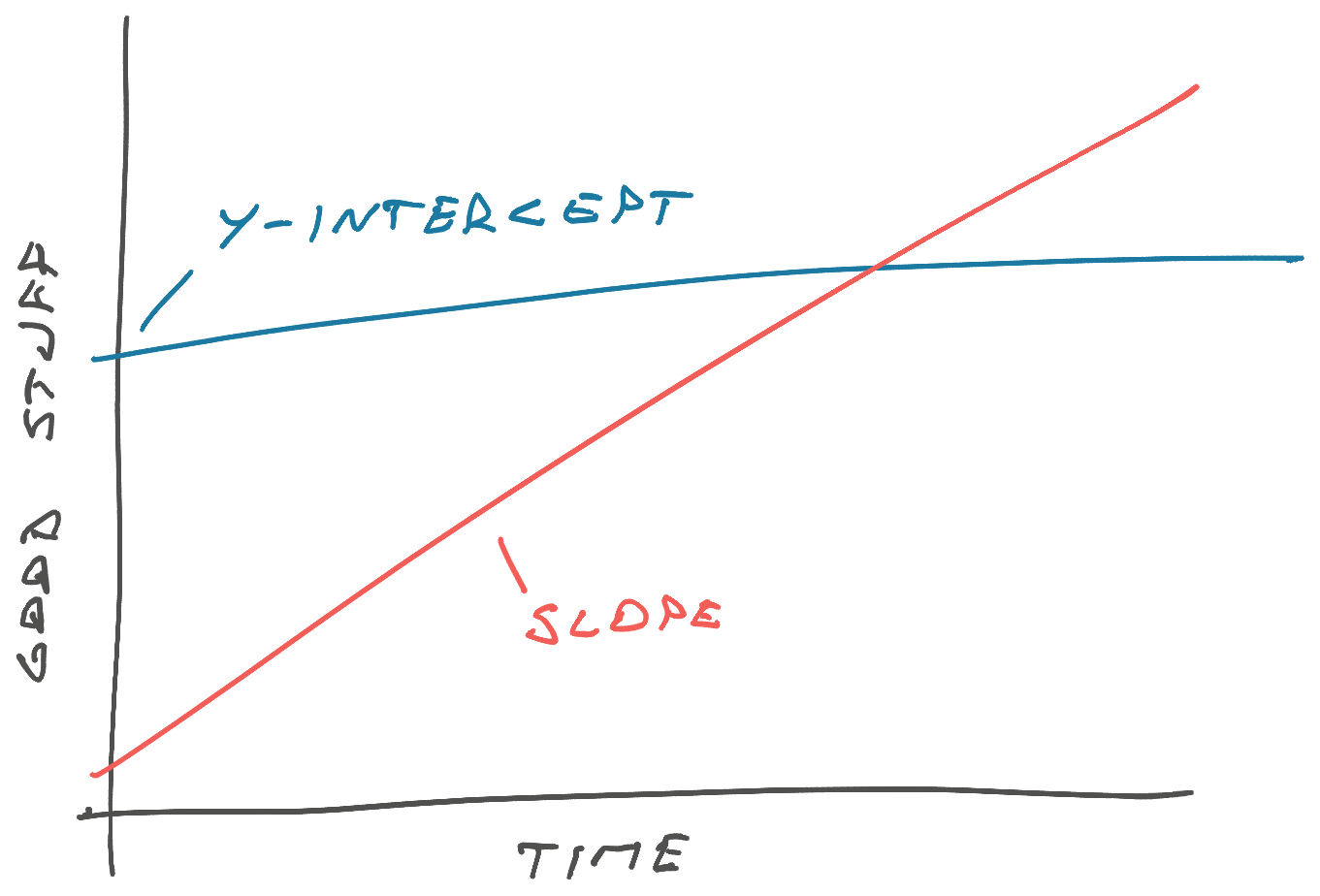
But be careful not to stagnate. A little bit of slope makes up for a lot of Y-intercept.
What if you want to grow?
I've written about this before from my own experience 👉 How to grow as a senior engineer or why I got a new job
As someone who gets bored, I need increasingly harder challenges to stay engaged. Without that engagement my work becomes worse.
Two years ago I boiled it down to 4 options:
- Go into management
- Become an entrepreneur
- Find a company with bigger better challenges
- Become junior at new thing
For someone like Ryan who wants to stay hands-on, I would recommend finding bigger better challenges to solve. Leverages your experience, looks great on a resume, maybe forces you to learn a new approach.
Solving bigger better challenges
Bigger better challenges come in many shapes.
You can find your way into a FAANG-size company and work on systems so massive every detail matters. I have a friend who removed NULL columns from a database and saved gigabytes of disk space. That's hard to do.
You can join a fast-paced startup early in their S-curve and experience the attitude of "Anything but slowing growth with technology problems". That can be fun.
You can find a hard problem with high stakes. Like the system we're currently rewriting at work with a multi million dollar contract on the line. The code will be easy, basic CRUD, but we've been domain and team modeling for a month. Fun!
Bigger means the stakes are higher. And that's exciting.
Better means the problems are new. At least to you, if not the world. My favorite indication of a better problem is when Google stops being useful.
Cheers,
~Swizec