Swap useReducer with XState – CodeWithSwiz 13
In Refactoring a useReducer to XState, pt1 we talked about a 5 step process to turn a reducer into an XState state machine. Today answers "Ok now what?"
CodeWithSwiz is a twice-a-week live show. Like a podcast with video and fun hacking. Focused on experiments. Join live Wednesdays and Sundays
useAuth relies on the Wormhole state management principle. Heck, that's where I first figured it out!
This has made lots of people very confused. Me included. Come back 6 months later trying to fix a bug and why is there a dispatch({ type: 'startAuthenticating' }) in 5 different places wtf??

"Don't invent new state management schemes, got it" right? No. Don't make your core state messy and confusing 😉
A primer on how useAuth makes wormholes
Wormhole state management gives you global state without the overhead. You add useAuth to your component and magic happens.
Internally useAuth connects to a react context holding your authentication state. Info about the user, their current state, faux cookies, and returns helper methods.
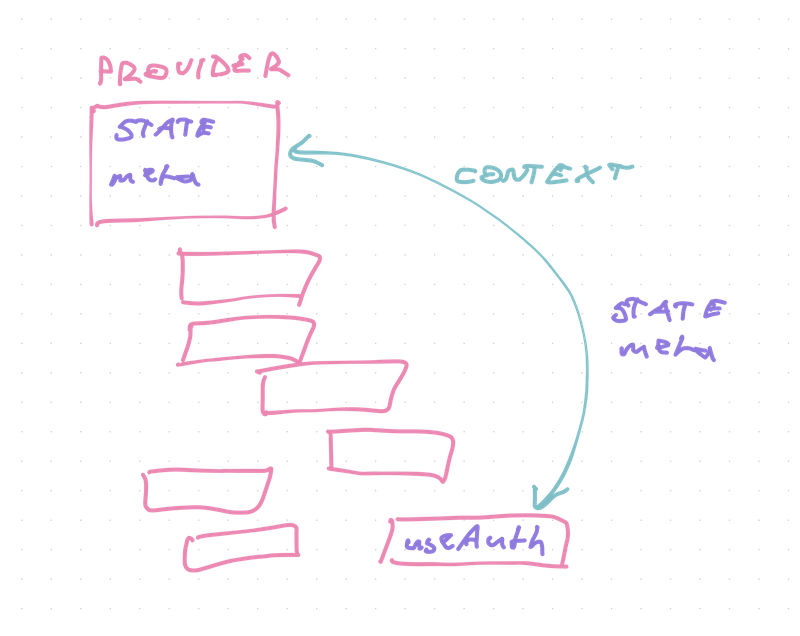
That happens in a couple steps:
// src/AuthProvider.tsx

export const AuthContext = createContext<AuthContextState>({
  state: getDefaultState(),
  dispatch: () => {},
  auth0: null,
  callback_domain: "http://localhost:8000",
  customPropertyNamespace: "http://localhost:8000",
  navigate: (path: string) => {},
})
This creates a new context with default values. state is the application state we're managing, dispatch is the changer method, the rest is meta data and configuration. Values we need everywhere that don't change.
// src/AuthReducer.tsx

// Holds authentication state
const [state, dispatch] = useReducer<React.Reducer<AuthState, AuthAction>>(
  authReducer,
  getDefaultState()
)

const [contextValue, setContextValue] = useState<AuthContextState>({
  state,
  dispatch,
  auth0,
  callback_domain: callbackDomain,
  customPropertyNamespace,
  navigate,
})

// Update context value and trigger re-render
// This patterns avoids unnecessary deep renders
// https://reactjs.org/docs/context.html#caveats
useEffect(() => {
  setContextValue((contextValue: AuthContextState) => ({
    ...contextValue,
    state,
  }))
}, [state])
The provider instantiates a new reducer and gets access to current state and a dispatch method. These and the config metadata are shoved into a new useState.
We use an effect to update the context value when reducer state changes. This ensures re-renders happen only when the reducer makes a change.
useAuth wormholes into this state with a useContext.
// src/useAuth

export const useAuth: useAuthInterface = () => {
    const {
        state,
        dispatch,
        auth0,
        callback_domain,
        navigate,
        customPropertyNamespace
    } = useContext(AuthContext);
Anything inside useAuth now has access to these values. Helper methods can check state, dispatch reducer actions, and look at the meta values.
Works great.
How XState helps us improve
Wormhole state worked great but the reducer was problematic. Convoluted to understand and difficult to use.
startAuthenticating fires twice in the code, so does stopAuthenticating. Why? Both where it doesn't make sense.
An XState state machine makes the flow clearer 👇
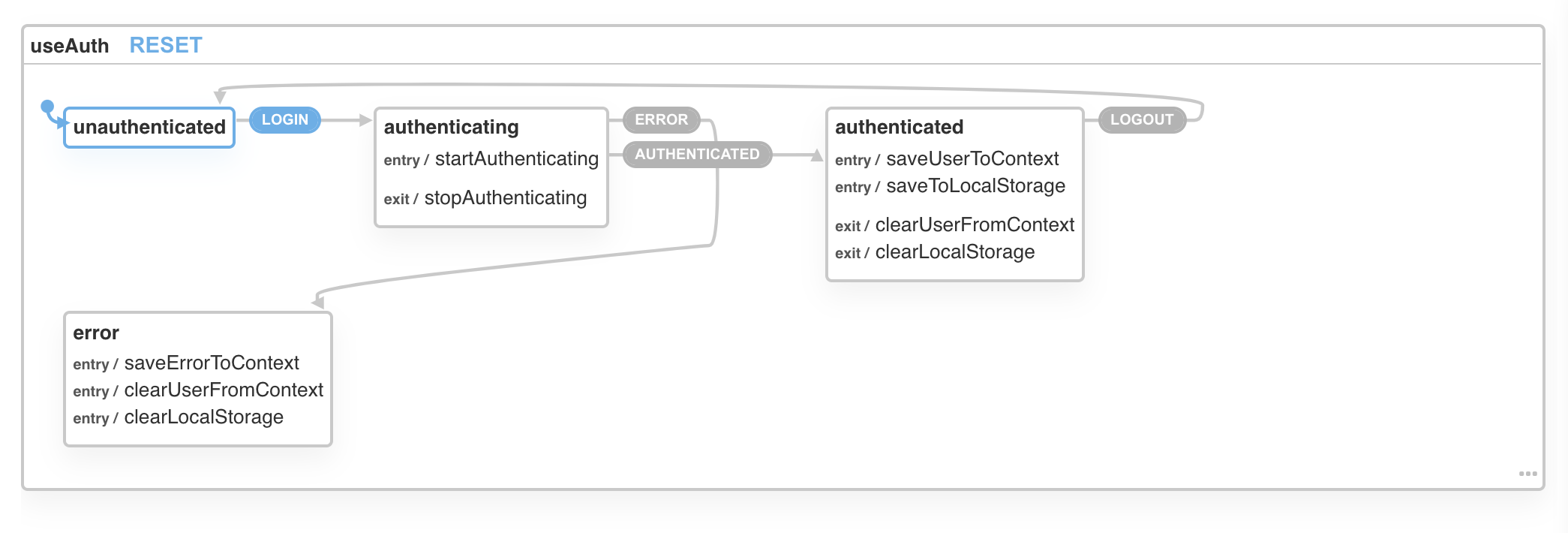
You start as unauthenticated and trigger LOGIN. That moves you to authenticating. From there you can get an ERROR, which puts you in the error state. Or you get AUTHENTICATED and move into the authenticated state.
LOGOUT moves you back to unauthenticated.
Makes sense eh?
While refactoring, we made the state machine closely follow the reducer implementation.
Means we can do a swap!
Change useReducer to useMachine from XState
// src/AuthProvider.tsx

// Holds authentication state
const [state, dispatch] = useReducer<React.Reducer<AuthState, AuthAction>>(
    authReducer,
    getDefaultState()
);

👇

// Holds authentication state
const [state, send] = useMachine(authMachine);
Change what goes into context:
const [contextValue, setContextValue] = useState<AuthContextState>({
    state,
    dispatch,

👇

const [contextValue, setContextValue] = useState<AuthContextState>({
    state: state.context,
    send,
Dispatch becomes send and state becomes the XState context. Yes we're overloading terms and that's unfortunate. State machine context is where we keep our application state.
Make the same state fix in the effect:
useEffect(() => {
    setContextValue((contextValue: AuthContextState) => ({
        ...contextValue,
        state
    }));
}, [state]);

👇

useEffect(() => {
    setContextValue((contextValue: AuthContextState) => ({
        ...contextValue,
        state: state.context
    }));
}, [state]);
And then it's a schlep to go around the codebase and change every dispatch({ type: X }) to send(X).
We went from 9 dispatch() calls to 9 send() calls, which doesn't sound like an improvement. 🤔
But it's because state machines are strict and we used 2 sends to hydrate from local storage. useReducer let us fake that part.
😅
Next step
David, the creator of XState, says we can stop using a context provider. And that's what we're gonna try next.
Cheers,
~Swizec
PS: continue reading with part 4 👉 React context without context, using XState