Why null checks are bad
Last week we talked about how small decisions can lead to big changes in your codebase. We used null-checks as an example but didn't explain why those are bad.
It's about exploding complexity.
Starts simple
Take a basic React component for example. It takes a user and renders their info. Like for a page header.
type User = {
  name: string
}

function UserInfo(props: { user: User }) {
  return <div>{props.user.name}</div>
}
We have a User type that defines properties and a component that takes user as a prop. It then renders the user's name.
How would you test this?
There is 1 important state
In theory, this component has an infinite number of states. The name string can be anything.
But you can rely on React and browser rendering to work. You only need to test that when you pass a user name, it renders.
test('renders username', () => {
	let component = renderer.create(
		<UserInfo user={{ name: 'Swiz' }}> />
	)

	expect(component.toJSON()).toMatch(
		'<div>Swiz</div>'
	)
})
A null check doubles your important states
Let's see what happens when a user's name may be undefined and we want to show a default.
type User = {
  name?: string | null
}

function UserInfo(props: { user: User }) {
  return <div>{props.user.name || "Unknown"}</div>
}
The name property may be undefined or null. We can treat those the same because there is a special circle in hell for people who use the difference between undefined and null for program logic.
Altho it can be useful sometimes. I've done it 😇
When the username is undefined, our component now shows Unknown instead.
How many tests do you need now?
There are 2 important states
You now need to write 2 tests to verify this component works.
test('renders username', () => {
  let user = { name: 'Swiz' }
	let component = renderer.create(
		<UserInfo user={user}> />
	)

	expect(component.toJSON()).toMatch(
		'<div>Swiz</div>'
	)
})

test('renders Unknown', () => {
  let user = {}
	let component = renderer.create(
		<UserInfo user={user}> />
	)

	expect(component.toJSON()).toMatch(
		'<div>Unknown</div>'
	)
})
The first test verifies rendering the username, the second test verifies the default state.
If you don't trust JavaScript's || operator, you could add another test for an explicit name: null value.
And you might notice I wrote a bug. Empty usernames render as Unknown. 💩
That's where fuzzing is useful. Finding little edge cases like that.
Every null check doubles your states
Now here's where it gets crazy. Every null check doubles the number of tests you need.
type User = {
  name?: string
  avatar?: string
  karma?: number
}

function UserInfo(props: { user: User }) {
  const { user } = props

  return (
    <div>
      {user.avatar ? <img src={user.avatar} /> : <DefaultAvatar />}
      <label>{user.name || "Unknown"}</label>
      <p>{typeof user.karma === "undefined" ? "🐣" : user.karma}</p>
    </div>
  )
}
Show user avatar or a default. Show their name or 'Unknown'. Show their karma or 🐣.
How many test cases does this component need?
That's right! 8.
Add one more and you get 16. At 5 nullable properties, you're looking at 32 combinations. 2^N(nulls) adds up fast 🙃
And if you're treating undefined and null as different, that formula becomes 3^N(nulls).

How to solve exploding complexity
Truth tables are my favorite tool in this case. Write out all your nullable variables, iterate their states, cross out what's impossible.
Here's an example from an article about How tests uncover hidden complexity in your code
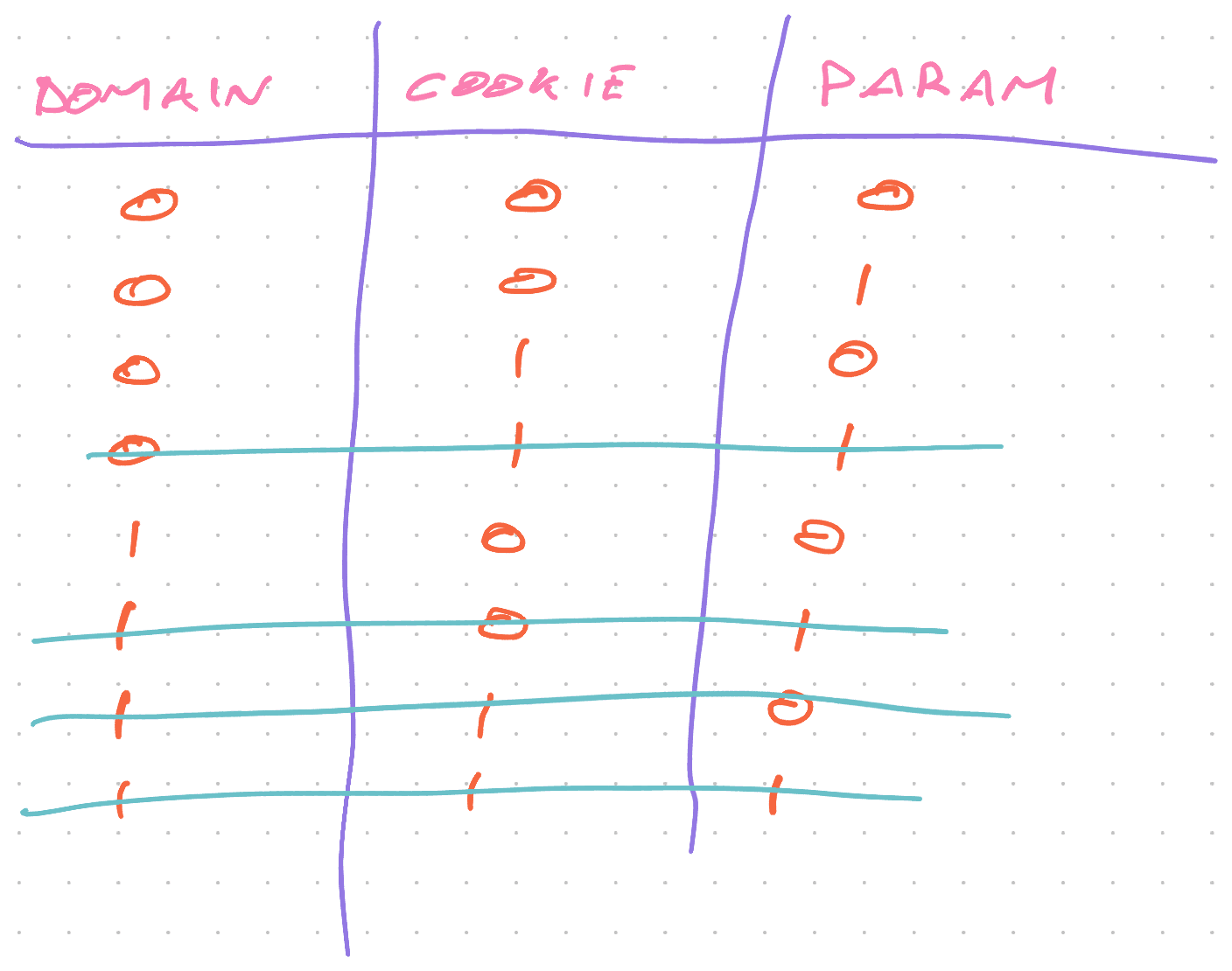
You take the rows that aren't crossed out and write tests. Or decide that's way too many states and simplify your code.
When you have lots of transitions between states, I like to use XState. Helps when your brain is breaking ☺️
Cheers,
~Swizec
PS: I'm calling it a null check because that's the standard phrasing. JavaScript just happens to have 2 different null-ish values – undefined and null