Why serverless fits side-projects perfectly
We've talked about how a $12 AWS bill runs a $50k business. Today let's talk about why.
Think about the load on this newsletter builder:
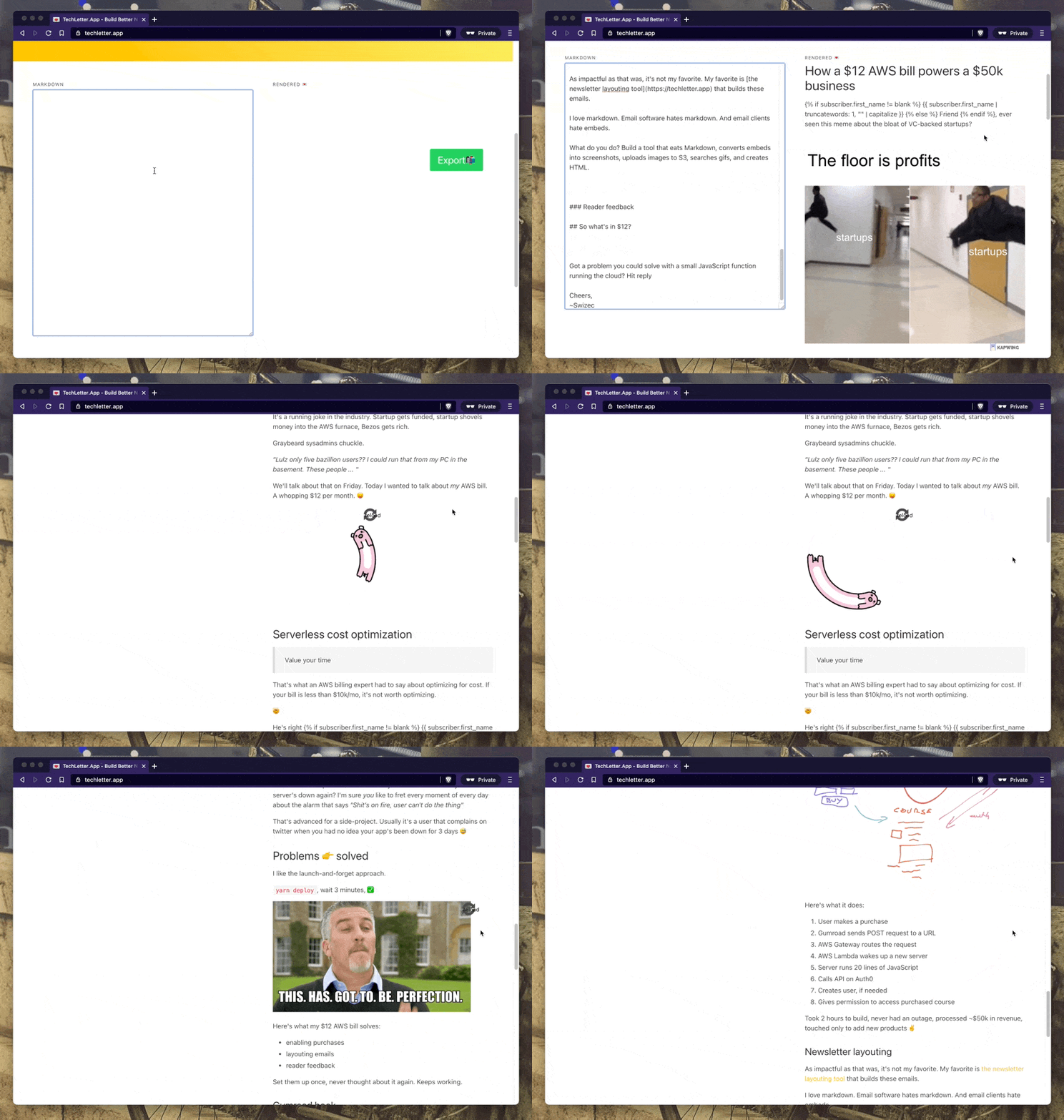
How do you think it works?
TechLetter.app architecture
The frontend for TechLetterApp is a create-react-app project. Nothing fancy. You can see the code on GitHub.
It runs on Vercel, using their git integration. git push origin master deploys new code in 2 minutes.
On the left, a <textarea> uses onChange callbacks to update values in global state. Shared via context in a cumbersome way because I was new to context 2 years ago. 😇
// MarkdownInput.js
export default () => (
  <Consumer>
    {({ markdown, onChangeMarkdown }) => (
      <React.Fragment>
        <Heading>Markdown</Heading>
        <Textarea onChange={onChangeMarkdown} value={markdown} />
      </React.Fragment>
    )}
  </Consumer>
)
Every change triggers a re-render of the LetterRender component. This detail is important.
// LetterRender.js
export default React.forwardRef((props, ref) => {
  const { markdown } = useContext(MarkdownContext)
  const rendered = useRemark(markdown)

  return (
    <div ref={ref}>
      <Heading>
        Rendered{" "}
        <span role="img" aria-label="face">
          {" "}
          💌
        </span>
      </Heading>
      <Content>{rendered}</Content>
    </div>
  )
})
useRemark() turns markdown into React
See this line?
const rendered = useRemark(markdown)That's the frontend secret sauce.
A compiler that takes Markdown and uses a chain of open source and custom remark plugins. One of the components it creates is called <Screenshot>.
// Screenshot.js
function Screenshot({ node }) {
  const [image, setImage] = useState(loaderImg)

  const reloadImage = async () => {
    setImage(loaderImg)
    try {
      const res = await fetch(node.url),
        response = await res.json()

      if (response.status === "success") {
        setImage(response.url)
      } else {
        throw "Screenshot error"
      }
    } catch (e) {
      setImage(errorImg)
    }
  }

  useEffect(() => {
    reloadImage()
  }, [node])

  // display image
}
Screenshot is important 👉 makes an API request const res = await fetch(node.url) every time you sneeze.
Look at this:
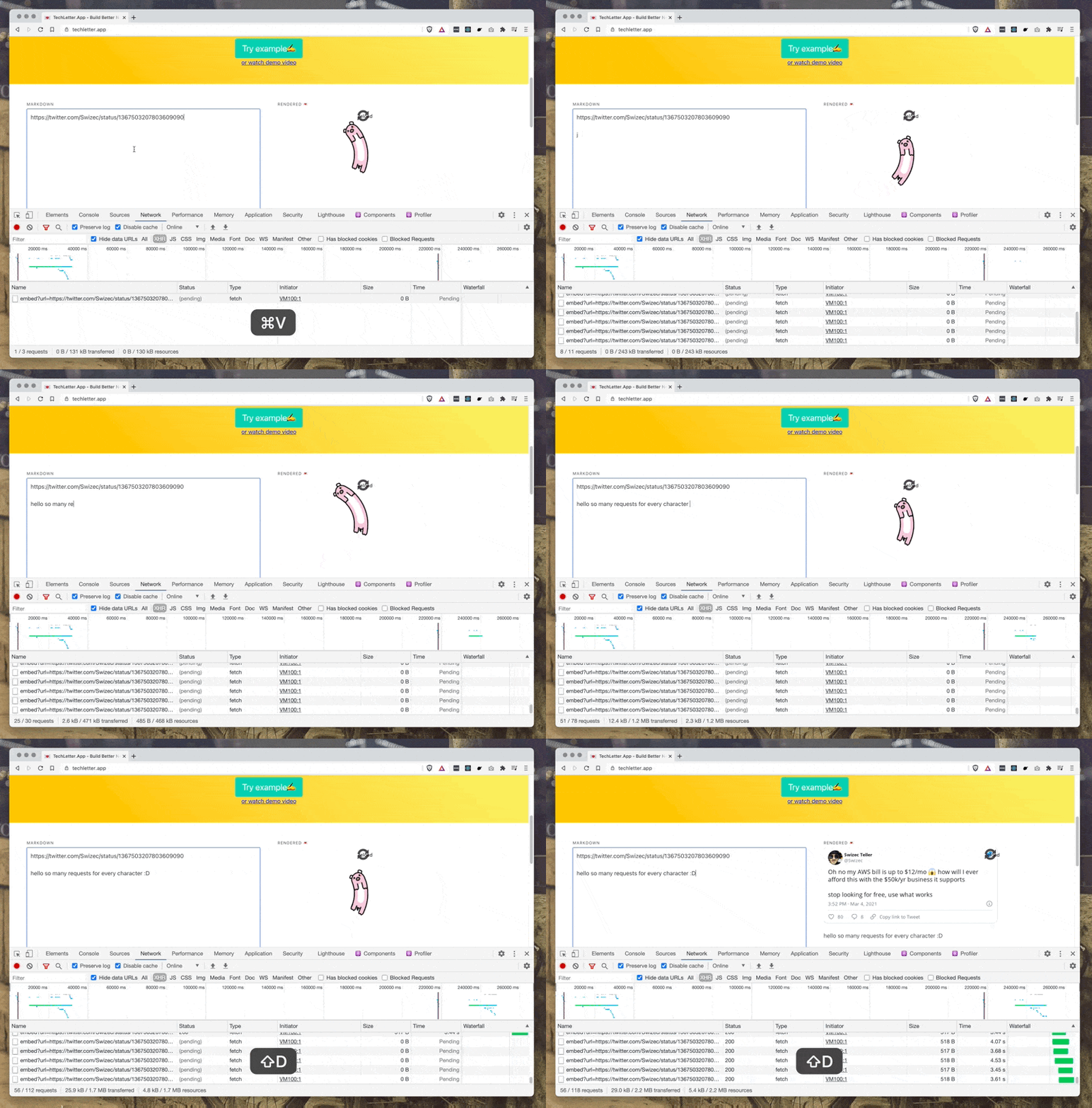
soooooo many requests, every character triggers a new one 😂
I knew it was bad, but I didn't realize it was that bad until I made this gif.
PS: it's because node changes object identity on every change. Effect should run on node.url.
A traffic pattern that kills your project
Every one of those requests talked to a server. The server had to:
- Run Chrome in headless mode without UI
- Load a special tweet embedder site running on Vercel
- Wait for the page to load
- Find the right DOM node
- Measure its size
- Take a screenshot
- Save to a temporary file
- Upload that file to S3
- Return the S3 link
Now imagine doing that 120 times while you type a sentence. Or 20 times all at once when you paste a document.
Server doesn't know you're bailing my friend, it finishes the full cycle every time. Yes my S3 is full of crap 😅
What do you think traffic looks like?
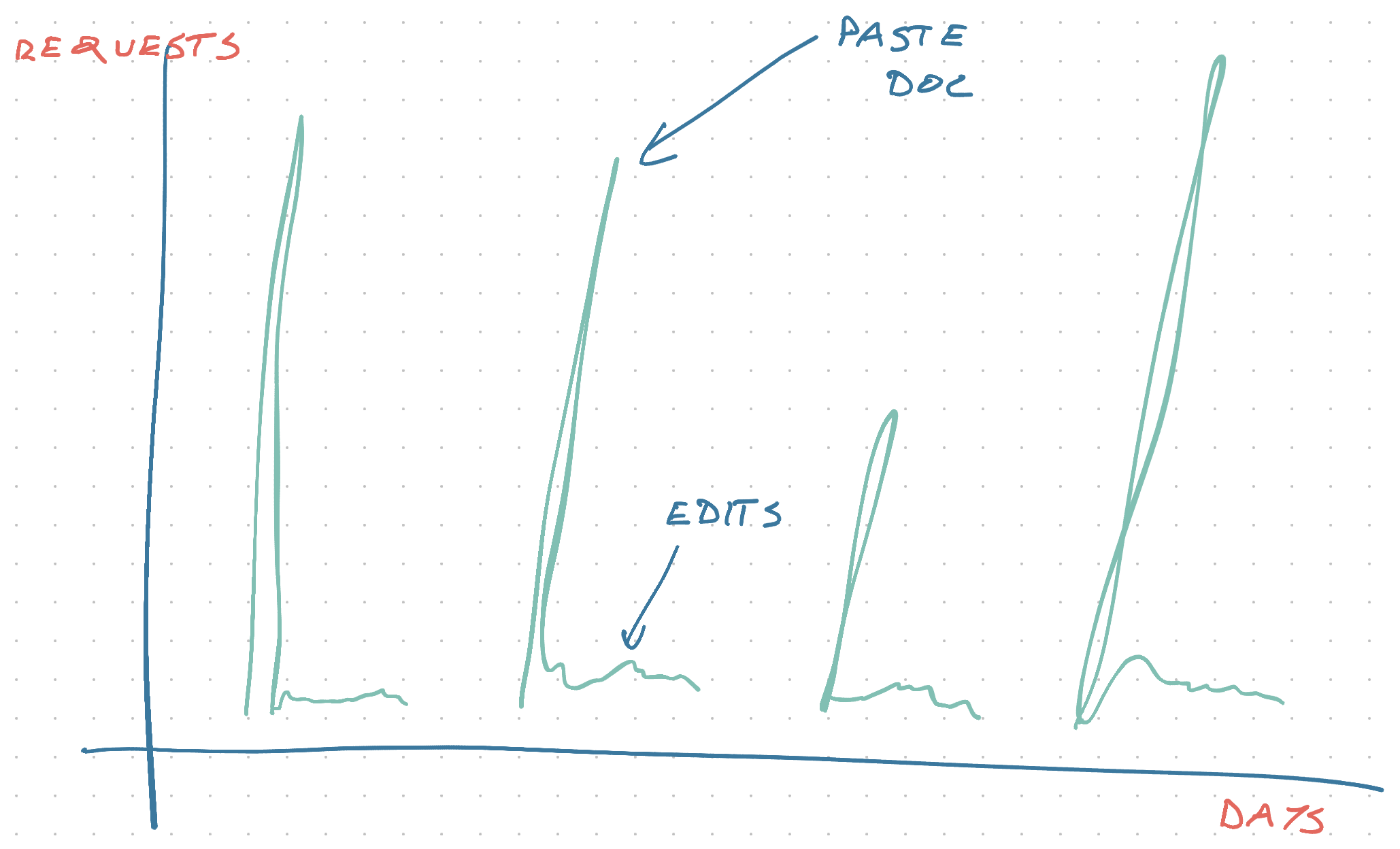
Days of nothing followed by a huge spike followed by lots of nothing. Your worst nightmare.
How many servers do you set up? 🤔
How serverless makes this work
Traffic like that is where serverless shines.
Google likes to call serverless architectures from prototype to production to planet-scale.
You don't want to use serverless at planet scale, but Google is right: Serverless scales. A lot.
With serverless, you don't need to think about traffic patterns and provisioning. Average load? Peak load? Lowest load? Auto-scaling? Who cares 🤷♀️
At rest, serverless does nothing. No requests, no server, no cost.
When ALL THE REQUESTS COME, serverless rallies the troops.

Each request creates a new server in milliseconds. Fastest I've seen was in the 20ms range for small functions. The screenshot lambda takes about half a second. Needs to run Chrome and Chrome is fat 🙃
You get up to 1000 of these in parallel on AWS. Other providers are different.
And I don't mean 1000 requests per second, oh no, I mean 1000 servers all at once. If your code takes 50ms to run, that's 50,000 requests per second. 🚀
Speed depends on what you're doing. Screenshots are slow.
What about traditional servers?
Now imagine TechLetterApp didn't have scale on demand ...
You have 2 options:
- Servers for average load – 2 requests per day 🤨
- Servers for peak load – 200 requests per minute 💸
Both suck.
A newsletter builder that can do 2 screenshots per day is useless. Takes you a week to build 1 email.
Scale to peak load of 200 per minute and you're throwing money in the furnace. Can you imagine the cost?
You end up with a middle ground: Enough servers to work okay but not great.
And that's how I kept crashing my friend's side project and nagging him on Slack every night while getting the Serverless Handbook print ready. He built a tool that takes markdown and turns it into a print PDF. Runs a render on every save.
It crashed. A lot. Shit's hard 😅
What do you think? Getting ideas yet? 😛 Hit reply
Cheers,
~Swizec