You though computer science has no place in webdev? Here's a fun coding challenge
Friend, you don't often get to show off your leetcode skills at work. They get you through the whiteboard interview and vanish forever.
Yesterday I ran into a rare challenge that let me use those skills. Thought I'd share ✌️
You've got this string of buggy JSX.
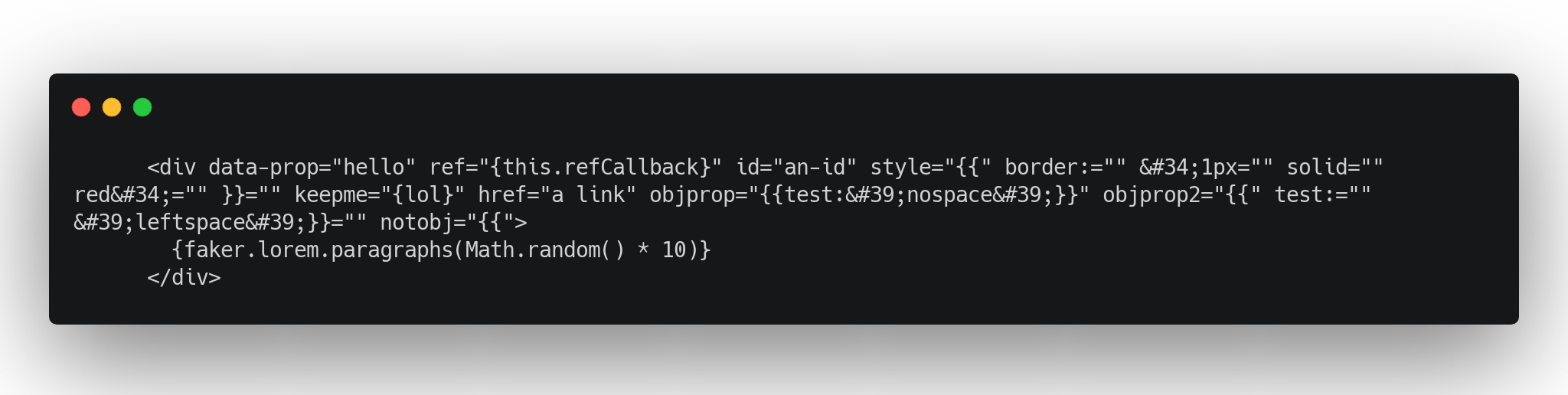
JSX confused an HTML parser–stringifier and this is what happened. You can't put it back through a parser because now it's neither valid HTML nor valid JSX. 😅
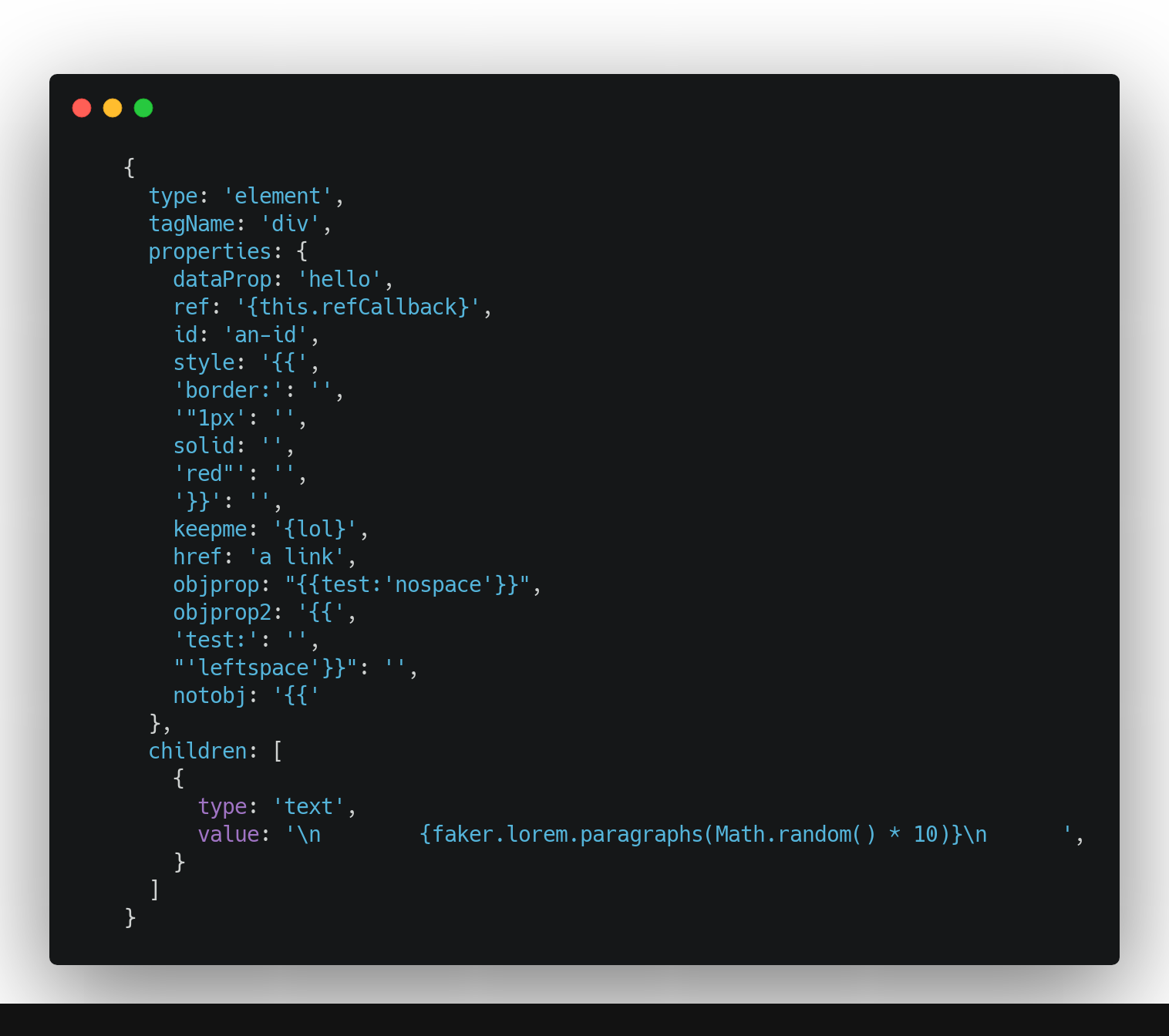
Here's the data model – part of an abstract syntax tree – that produces the above result:
And here's the output you want:
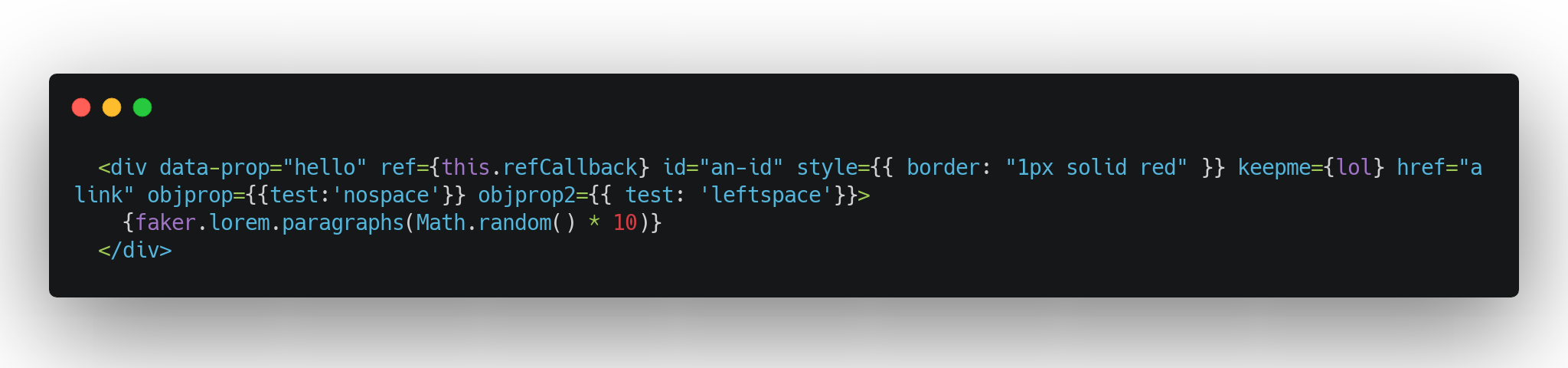
The tools to stringify your AST exist 👉 toHTML(tree)
But you need to:
- avoid quotes around JSX props denoted by
{} - avoid breaking JSX object props denoted by
{{ }}
Looks like the parser takes every space as a new attribute. The stringifier wraps every attribute in quotes.
Have fun ❤️
Here's a codesandbox I prepared, if you want to play around.
Give it a shot before you read on, at least a little think.
Did you finish the challenge? Had fun?
I did :P
You can solve this challenge in 2 parts.
- fix quotes around JSX props denoted by
{} - fix JSX object props denoted by
{{ }}
Each issue falls on a different level of computational solvability. That's a bad phrasing for a 2 semester class I took in college.
In computer science you have automata theory. It teaches you the classes of approaches that can solve different classes of computational problems.
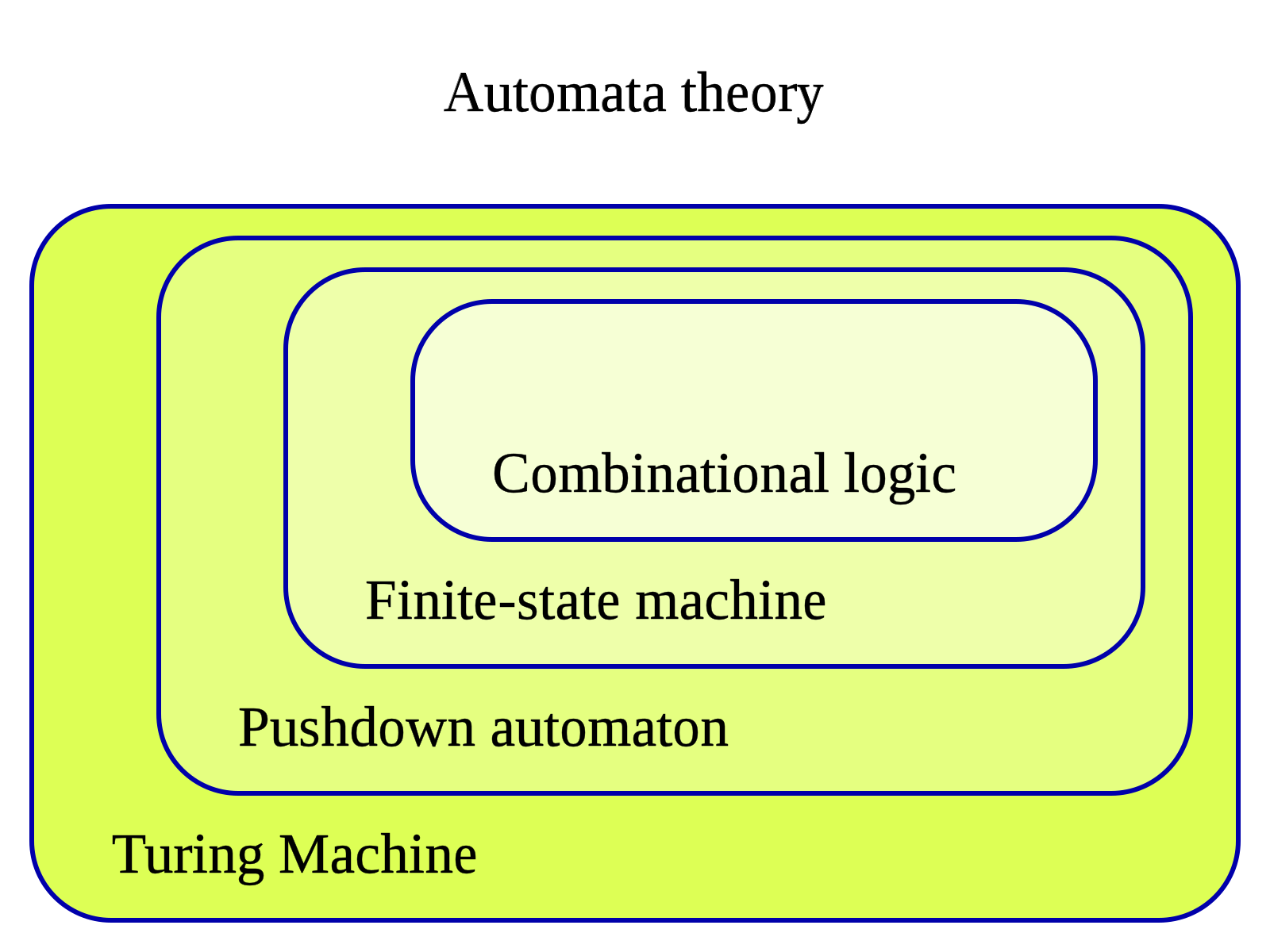
The other side of this coin are languages. Regular languages, context-free languages, context-sensitive languages. It goes on.
Math gibberish for:
- you can use finite state machines to parse regular languages
- you can't for context-sensitive languages
Easiest way to know which you're facing 👉 if you have to match open/close parentheses, you're dealing with context.
Fix quotes around {}
You can solve the first part by summoning Cthulhu.
Here's the bit that summons Cthulhu and solves our problem:
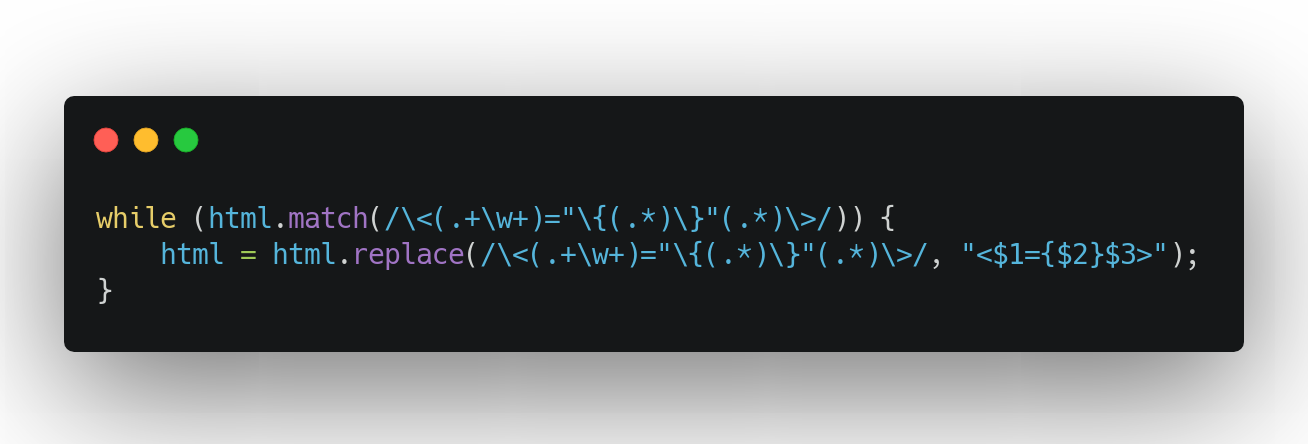
This code uses regex to fix HTML even though HTML is not a regular language and is therefore not parseable by regex.
Why does it work then? 🤨
It works because it doesn't rely on matching open/close tags. Looks like it does, but it doesn't.
This part here /\<(.+\w+)="\{(.*)\}"(.*)\>/ asks for: "Give me any pair of "{ }", matched or not, that appears between any pair of <>, matched or not
The regex returns 3 matched groups:
- everything before the pair
- everything inside the pair
- everything after the pair
We use those groups to replace with a fixed string:
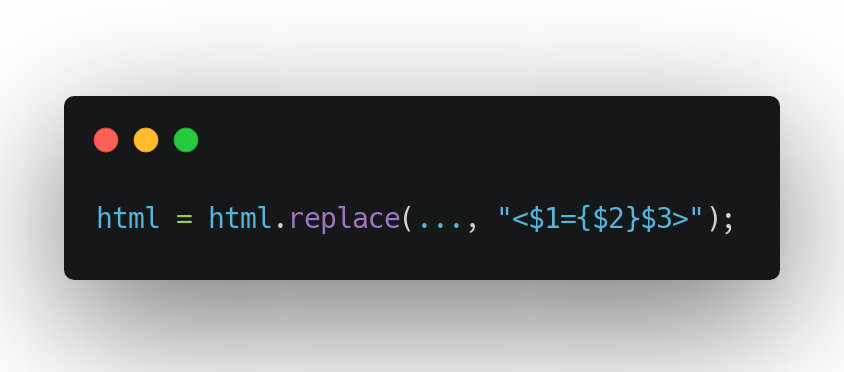
Open <, first group, ={, second group, }, third group, close >. Then repeat in a loop until no more candidates are found.
Matching never matters and that's why this works.

Fix broken {{ }} props
The broken object props are harder. Here you are dealing with a contextual language – you have to match the open {{ to its nearest closing }}.
If you don't, you'll get the wrong result.
That means you have to solve this one before stringification. When you still have access to the underlying AST.
My idea was to iterate through the props and collect them into a new object. When you hit {{, start collecting values into a new prop, add to new object as full prop when you hit }}.
Here's how:
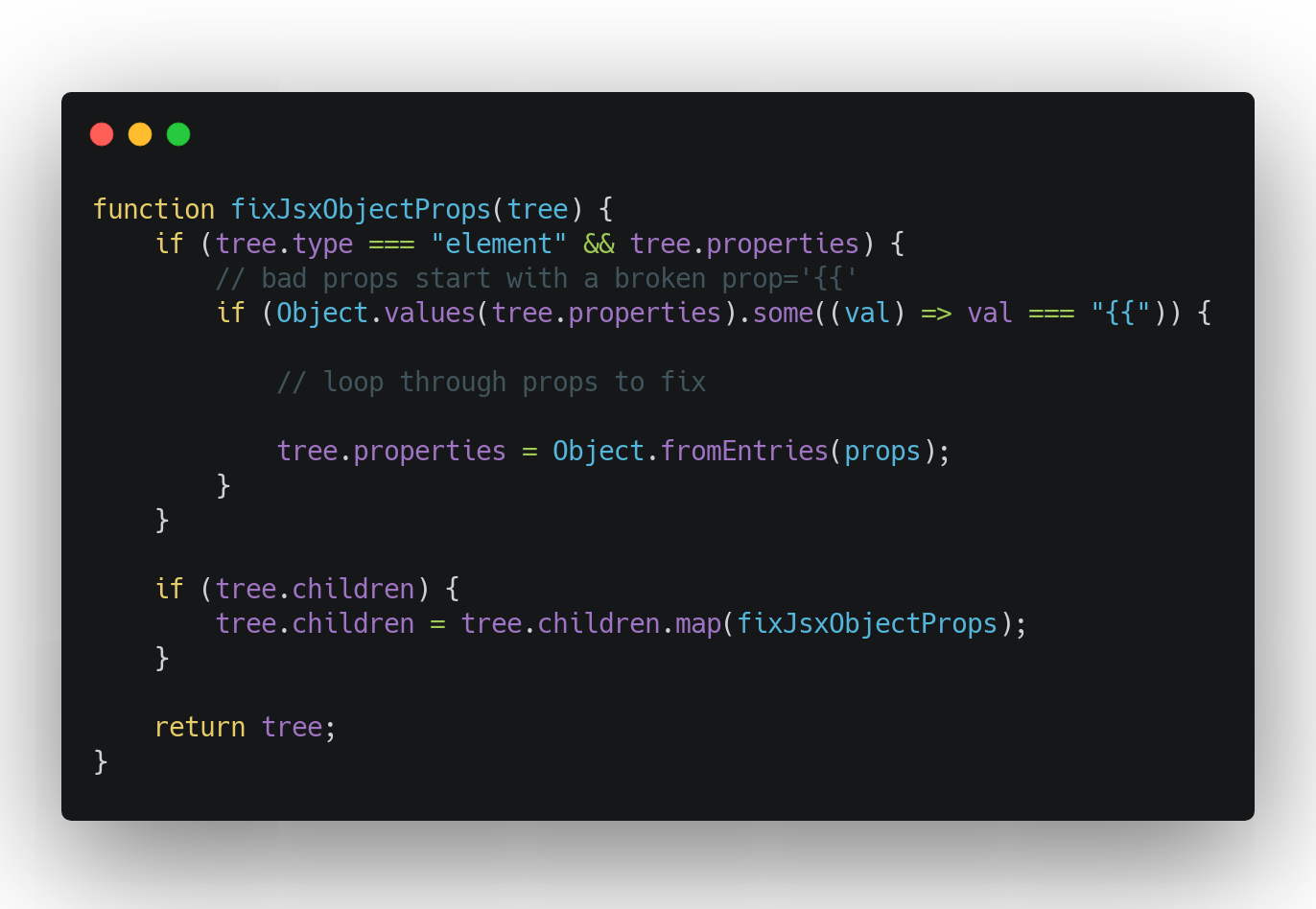
This code sets up a method that recursively visits all children in a tree. Makes it useful in a more general case.
Start the algorithm if you encounter an element with {{ in its properties.
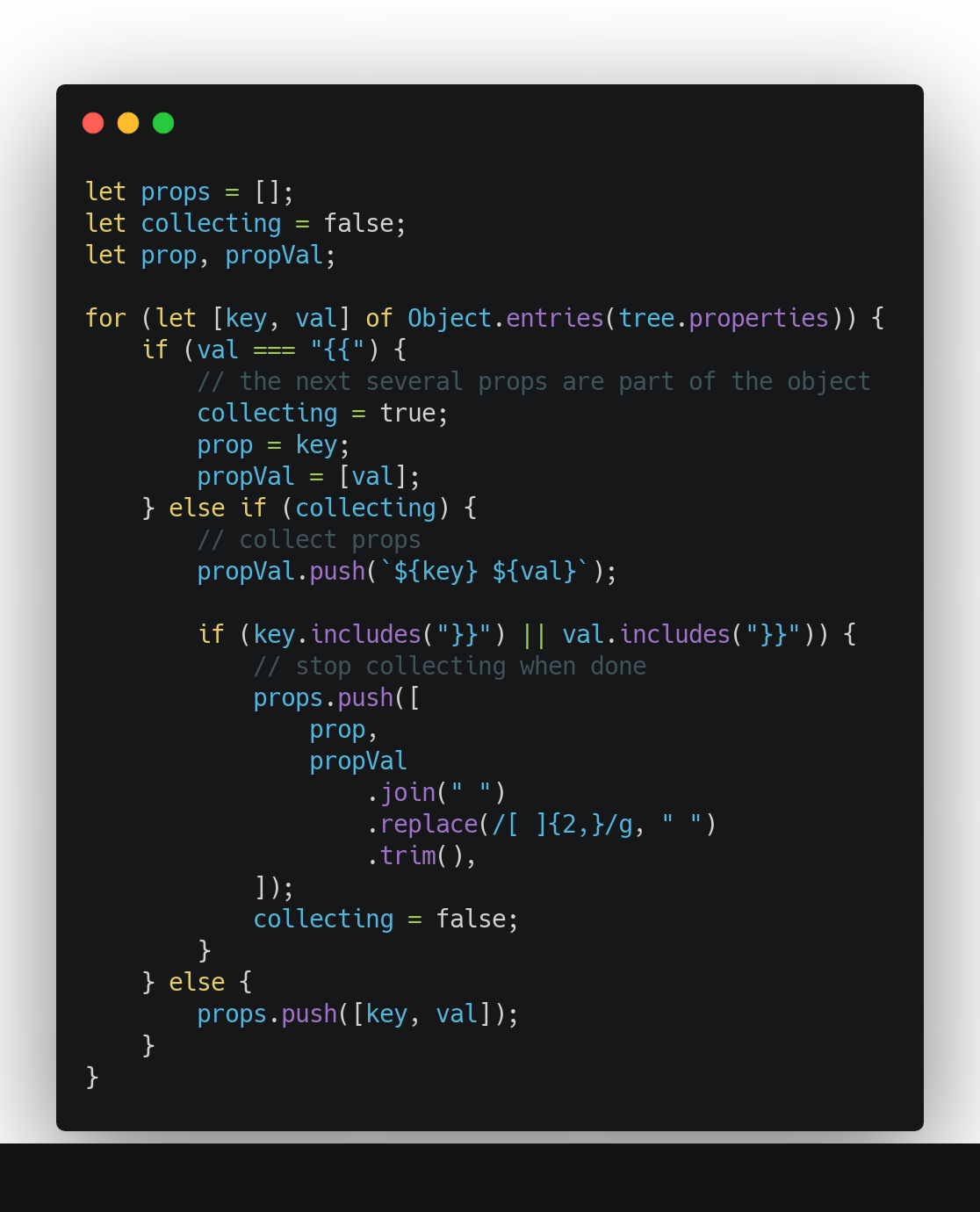
Prep a value for new props, a flag that says when you're collecting, and 2 variables to collect into.
Then you iterate and:
- if
{{is encountered, start collecting - if you're collecting, add values to the current prop
- if
}}is encountered, stop collecting and create a new prop - push unchanged prop to new object normally
Final Object.fromEntries call takes the generated array of [key, value] pairs and turns them into a properties object.
Upon stringification, this gets wrapped in " quotes, but the Cthulhu summoning code fixes that.
And you get the correct result. Here's a codesandbox for proof
And you thought computer science was useless in web development. Ha!
Cheers,
~Swizec